


English | 中文(简体) | 한국어 | 日本語(完全版)
If you are raising a child in Japan, or visiting with one, you will find that choosing a stroller here follows different rules. Not cultural rules — physical ones. Japan’s railways, pavements and homes impose dimensional limits that simply do not exist in Europe or North America, and a stroller that ignores them does not become inconvenient. It becomes unusable.
This page sets out those limits in millimetres, and gives you a method for narrowing the field before you start comparing products. It is written by someone who has handled over 800 strollers in Japan since 2012 and answered more than 350 paid purchase consultations.
Everything here is given in centimetres, because that is how strollers and infrastructure are specified in Japan. Imperial equivalents are shown in brackets where they matter. As a rule of thumb, 1 cm = 0.39 in, and 10 cm = 4 in.
Start with subtraction, not addition
Most people choose a stroller by adding up good points. This one is light. That one looks better. This one rides well. With well over a thousand models sold in Japan, that comparison never ends, and people stall.
Do the opposite. Eliminate first. Decide which models cannot work in your life, remove them, and only then compare what survives. In practice this usually cuts the field from a thousand to a handful within an hour.
To do that you need two things measured: your home, and the roads you actually use every day.
1. Measure your home
The genkan decides more than you think
Japanese homes have a genkan — a recessed entrance area where outdoor shoes are removed and outdoor items are kept. A stroller lives here. It is not carried into the living space, because the floor beyond the genkan is a shoes-off surface.
Many genkan are smaller than one tatami mat — roughly 90 × 180 cm (3 × 6 ft) — and shared with everyone’s shoes and umbrellas. This produces the single most common regret we hear:
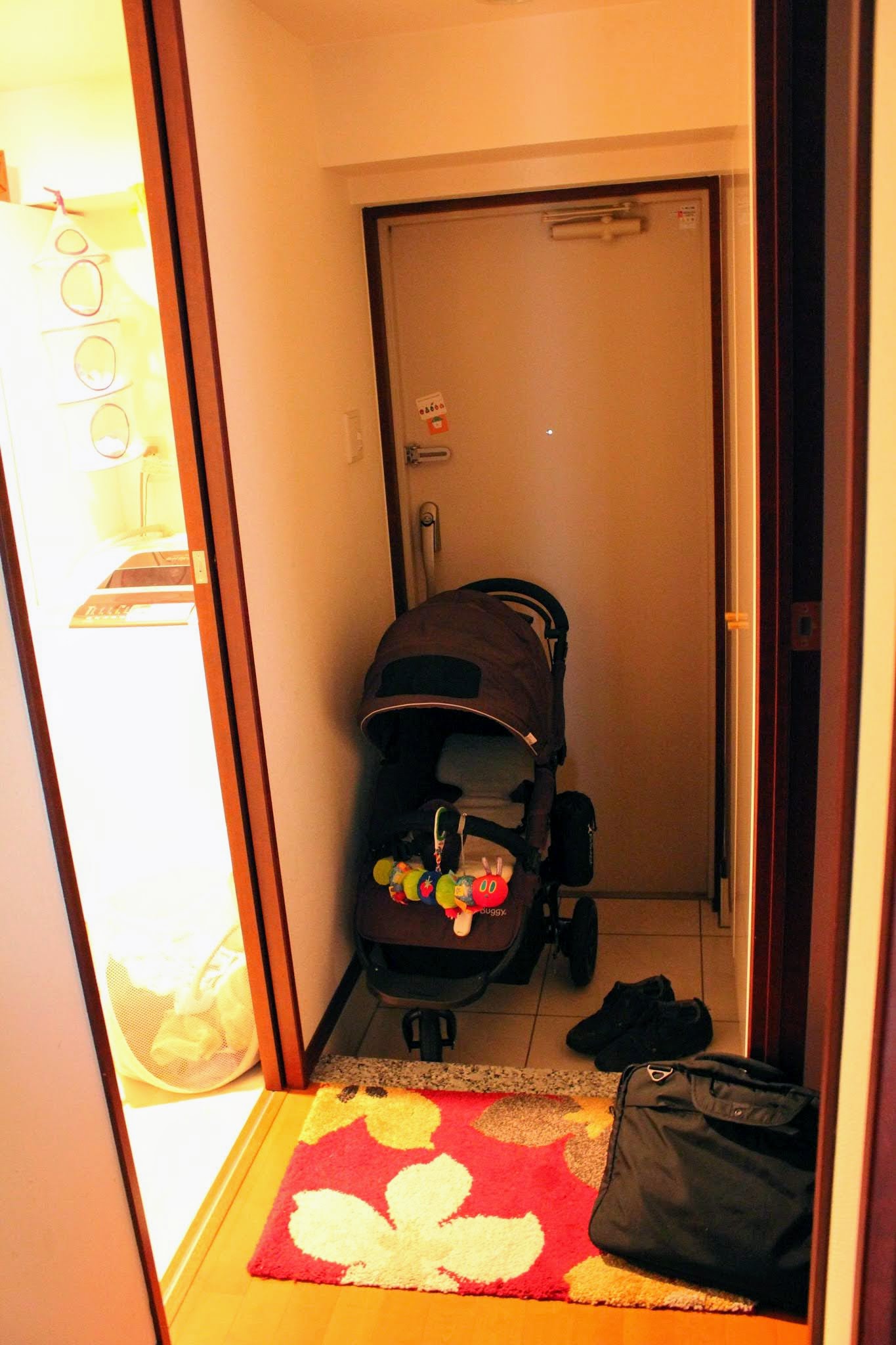
“It folds compactly” and “it fits in my genkan” are two different claims. Plenty of strollers fold in one direction while keeping their full height or width.
Measure the tightest dimension of the space where the stroller will actually stand — usually depth for a genkan, height for a car boot — and treat that as a hard limit.
Stairs, lifts, and the rain
- No lift in your building? Carrying a stroller up two floors daily is, in our experience, about the limit before people begin to resent the stroller itself. At three floors and above, weight stops being a preference and becomes a requirement.
- No porch or covered entrance? On rainy days you will fold and unfold inside the genkan, wet. One-handed folding matters far more than the brochure suggests.
- Where will it stand when folded? Free-standing when folded is worth checking. A stroller that must lean against a wall will fall over, usually onto someone’s shoes.
2. Measure the road, not the showroom
Japanese pavements are not flat, and this is deliberate. The national guidance for pavement construction specifies:
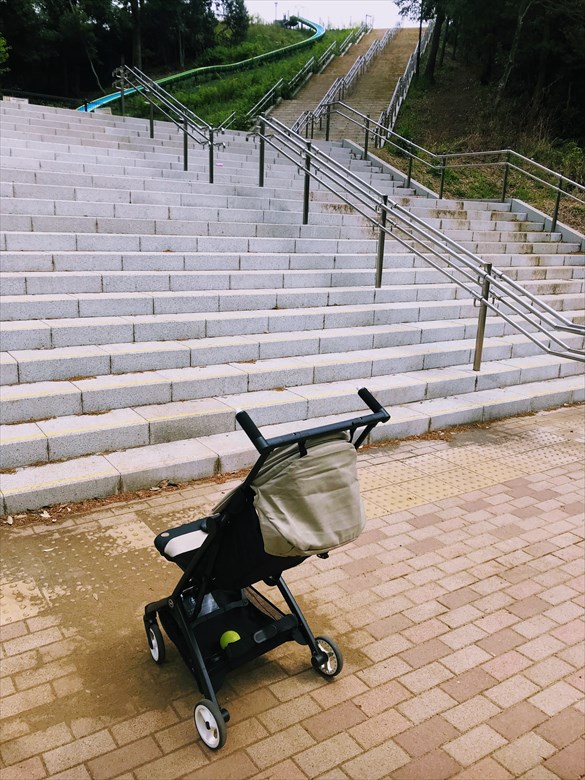
- A 2 cm kerb step retained as standard, so that visually impaired pedestrians can detect the boundary with a cane and underfoot
- Ramp gradients of 5% or less where the pavement drops to the road (8% where unavoidable)
- A 2% cross slope toward the roadway for drainage — specified in Article 24 of the Road Structure Ordinance
That last one deserves attention, because almost nobody mentions it. Every pavement in Japan tilts slightly toward the traffic. A stroller with poor straight-line stability drifts that way continuously, and you correct for it on every walk without noticing you are doing it. This is a fatigue mechanism that appears on no specification sheet.

On kerbs, published engineering work on hollow rubber tyres puts the practical climbing limit at roughly one quarter to one third of wheel diameter. Against a real 5 cm kerb, that sets a floor on wheel size which no amount of suspension tuning removes. If your daily route has frequent steps, gravel, or long slopes, treat small front wheels as disqualifying.
3. The four cuts
With those measured, apply these in order. Anything that fails is removed, regardless of how good it looks.
Cut 1 — Handle height, especially if you are tall
This is the cut that catches foreign buyers most often, and it catches them in the opposite direction to Japanese buyers.
A workable handle height can be estimated as:
Ideal handle height (cm) = 102 + (your height in cm − 167.5) × 0.15, with about ±3 cm (1.2 in) of tolerance.
You do not have to do the arithmetic. We run a free calculator that does it for you, and — because a stroller is usually pushed by two people — it takes both your height and your partner’s and returns the range that works for both:
handleheight.com(free, no sign-up, cm or inches)
The 167.5 cm in that formula is 5 ft 6 in. If you think in feet and inches, work in centimetres for this one calculation — the arithmetic does not survive the conversion cleanly.
Japanese-brand strollers are designed around Japanese stature. Using national statistics on height by age band, the couple buying a first stroller in Japan falls into a comfortable range of roughly 99.6 to 103.6 cm (39.2 to 40.8 in), and Japanese manufacturers build to it: about 71% of their fixed-handle models sit inside that range.
Now run yourself through it. If you are 180 cm (5 ft 11 in), the formula gives about 104 cm (41 in) — and a 100 cm (39 in) fixed handle will have you pushing with your back bent, every day, for two years. If you are taller than about 175 cm (5 ft 9 in), treat an adjustable handle as close to mandatory, and check the maximum height, not the minimum.
| Your height | Handle height you want |
|---|---|
| 160 cm / 5 ft 3 in | about 101 cm / 39.8 in |
| 170 cm / 5 ft 7 in | about 102 cm / 40.2 in |
| 180 cm / 5 ft 11 in | about 104 cm / 40.9 in |
| 190 cm / 6 ft 3 in | about 105 cm / 41.3 in |
The differences look small. They are not. A handle 4 cm below where your arms naturally fall changes your posture on every walk, and you will feel it in your lower back long before you work out why.
Cut 2 — Does it fit the genkan, folded?
Compare the folded dimensions against the tightest measurement you took. Not the advertised “compact fold” — the actual numbers, in the actual direction that matters for your space.
Cut 3 — Does it survive your daily road?
If any of these describe your route, remove models with small wheels and weak suspension:
- Steps of 3 cm or more, encountered regularly
- Steep slopes running more than about 20 metres
- Several places where the pavement tilts noticeably toward the road
- Stretches of gravel or broken surface
If your route is mostly flat and you drive, you can relax this cut considerably.
Cut 4 — Does it pass through the transport you use?
This is where imported strollers most often fail. See the table below.
4. The dimensions that decide it
Memorise only the numbers for the transport you actually use.
| Transport | What you need |
|---|---|
| Train ticket gates | Open width 54 cm / 21.3 in or less. Standard gate lanes are 55 cm (21.7 in); specifications run 55–59 cm. At 54 cm you have about 5 mm each side. Wide lanes exist for wheelchairs at 90–95 cm, but usually only one per station, and it queues. |
| Limited express trains | Open width 45 cm / 17.7 in or less. Aisles and footwells are narrower than on the Shinkansen. |
| Shinkansen | Under 55 cm / 21.7 in to move down the aisle. You cannot keep it at your feet — reserve an oversized baggage seat at the rear of each carriage. For strollers the fee is waived. |
| Buses (low-floor) | Under 55 cm / 21.7 in. On highway and minibuses, expect to fold and stow. |
| Taxi (JPN Taxi) | To board without folding: about 44 cm × 90 cm (17.3 × 35.4 in). If a sedan arrives instead, you fold. |
| Car (kei / compact) | Folded height under 60 cm (23.6 in), depth under 40 cm (15.7 in). |
| Aircraft cabin | Folded within 55 × 40 × 25 cm (21.7 × 15.7 × 9.8 in) and 10 kg (22 lb), plus each airline’s own rules. Gate-check is usually the saner option. |

The 54 cm figure is the one that matters most, because train gates are unavoidable in most Japanese cities. A number of well-regarded European strollers are 58–60 cm wide when open. They are excellent products. They will stop you at the gate.
Three mistakes we see repeatedly
Bringing your stroller from home
Understandable, and often wrong. Check the open width first. If it exceeds 54 cm and you will use trains, you are committing to the wide lane on every journey — which means finding it, walking to it, and waiting behind whoever else needs it.
Assuming lighter is better
Weight is bought with something. Usually rigidity, seat comfort, or wheel size. A very light stroller in which the child will not settle produces the worst outcome of all: you end up pushing an empty stroller with one hand and carrying the child with the other. Weight matters when you carry it up stairs. It matters far less if you drive, where folded dimensions matter instead.
Comparing before eliminating
If you are still comparing twenty models after a week, the problem is not indecision. It is that you never applied the four cuts.
Where to buy in Japan
- Online (Rakuten, Amazon.co.jp, Yahoo! Shopping) — usually the lowest real price once point rebates are counted. Rakuten’s point campaigns can move the effective price substantially.
- In store (Akachan Honpo, Babies R Us and similar) — worth visiting to push the thing, even if you buy online afterwards. Push it. Fold it. Lift it. Ten minutes here is worth more than ten hours of reading.
- Second-hand (Mercari) — viable, but check the year of manufacture and whether any warranty transfers. Fabric and wheels age faster than frames.
- Parallel imports — cheaper, but Japanese after-sales support generally does not apply. For a product carrying a child daily for two years, that is a real cost.
Note that some models in Japan are sold exclusively through a single retail chain and are not available elsewhere, including on the manufacturer’s own online shop. If you cannot find a model online, it may not be discontinued — it may be exclusive.
If you would like help
This site is Tokyo Babycar DB, published since 2012. We maintain a database of 1,173 products sold in Japan across 73 attributes, and we assess machines physically rather than from catalogues. We do not accept payment for placement or for favourable assessment.
The full Japanese-language guide runs to nine chapters and covers priorities, budgeting, how many strollers to own, and specific model recommendations by condition. This page is a condensed extract of the parts most relevant to living in Japan as a non-Japanese speaker.
Individual consultations are available in English. Tell us your home, your daily route, your transport, and your height, and we will propose specific models with reasons. Please write to [email protected] and mention that you would like an English consultation.
Questions and corrections are welcome at the same address.